


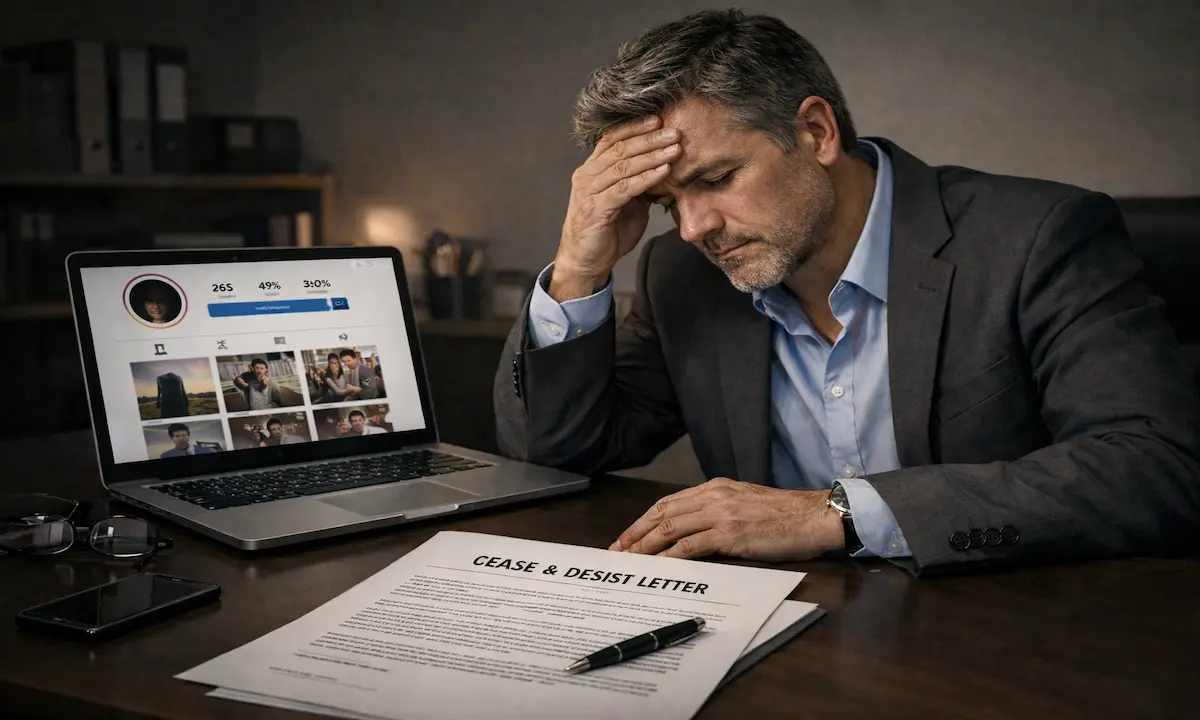
Three months ago, a marketing agency owner received a cease-and-desist letter from a competitor’s attorney. The claim? She had been “cyberstalking” their social media accounts using anonymous viewing tools.
Her defense of “just doing competitive research” didn’t hold up legally. She settled out of court for $12,000 to avoid a drawn-out lawsuit.
One anonymous viewer tool, three months of use, twelve thousand dollars in legal fees and settlement costs.
Anonymous Instagram viewers aren’t just risky for your account. They create legal exposure you probably haven’t considered.
As a social media consultant who has advised on eight legal cases involving social media monitoring tools, I can tell you that courts increasingly view persistent anonymous monitoring as harassment, regardless of your intentions.
This guide explains the real legal dangers, what actually constitutes online harassment, how Instagram enforces against these violations, and why legitimate business intelligence doesn’t require risky anonymous tools.
Key Takeaway
Using anonymous Instagram viewers offers almost no real advantage but creates serious risks. Account bans, harassment claims, and lawsuits happen because courts focus on repeated behavior, not intent. Legitimate research never requires anonymity.
What Makes Anonymous Instagram Viewing Dangerous?
Anonymous Instagram viewing tools claim to let you watch stories, view profiles, and monitor accounts without leaving any trace. These tools violate multiple legal and platform policies simultaneously.
How anonymous viewers work:

- Third-party websites or apps access Instagram data
- Tools bypass Instagram’s viewer tracking systems
- You see content without appearing in viewer lists
- Account owners remain unaware of your monitoring
Why does this create problems?
These tools violate Instagram’s Terms of Service automatically. They often require your Instagram credentials, compromising security. They circumvent the privacy features that Instagram intentionally built. They enable behavior that crosses legal boundaries into harassment territory.
Common anonymous viewer tools:
- Anon IG Story Viewer
- InstaStories Viewer
- Private Account Viewer
- Ghost Story Watcher
- Anonymous Profile Tracker
All of these tools operate in legal gray areas at best and violate Instagram’s policies explicitly. Using them creates both account risk and potential legal liability.
| Method | Account Risk | Legal Risk | Allowed by Instagram |
|---|---|---|---|
| Anonymous Instagram viewers | Very High | High | No |
| Viewing public profiles normally | None | None | Yes |
| Following competitors openly | None | None | Yes |
| Secondary research account | None | None | Yes |
| Compliant analytics tools | Low | None | Yes |
Legal Issues with Anonymous Instagram Monitoring

Anonymous viewing isn’t just against Instagram’s rules. It creates actual legal exposure in multiple areas of law.
Cyberstalking and Harassment Laws
Many jurisdictions now classify persistent anonymous social media monitoring as cyberstalking under criminal law.
Legal definition of cyberstalking: Using electronic communication to engage in a course of conduct that causes substantial emotional distress or creates reasonable fear in a person.
How anonymous viewing becomes cyberstalking:
- Repeated monitoring without consent
- Combined with other contact attempts
- Pattern of behavior over time
- Intent to intimidate or control
- Creating a reasonable fear of harm
State-level cyberstalking laws:
California Penal Code 646.9 makes cyberstalking a misdemeanor or felony. Conviction carries up to one year in jail for misdemeanor or up to five years for felony, plus fines up to $1,000.
New York Penal Law 120.45 classifies aggravated harassment in the second degree as a Class A misdemeanor. This includes using electronic communication to alarm or seriously annoy someone.
Texas Penal Code 42.07 criminalizes electronic harassment. Even anonymous monitoring combined with any unwanted contact can constitute harassment.
Privacy Law Violations
Anonymous viewers often violate privacy laws, including GDPR in Europe and various state privacy laws in the US.
GDPR violations:
Anonymous viewing tools that collect or process personal data without consent violate GDPR Article 6 (lawfulness of processing). Tools operating in or targeting EU users face fines up to 4% of global annual revenue or €20 million, whichever is higher.
Using these tools to monitor EU residents creates liability even if you’re based outside Europe. GDPR has extraterritorial reach, affecting anyone processing EU resident data.
California Consumer Privacy Act (CCPA):
Tools collecting data on California residents without proper disclosure violate CCPA. Individual users of these tools can face liability if their monitoring constitutes “selling” personal information as defined by the law.
State-level privacy torts:
Many states recognize “intrusion upon seclusion” as a civil tort. This covers intentionally intruding upon someone’s private affairs or concerns in a manner highly offensive to a reasonable person.
Persistent anonymous monitoring of someone’s social media, especially if combined with other behavior, can constitute an actionable intrusion upon seclusion.
Terms of Service as Enforceable Contracts
Instagram’s Terms of Service constitute a legally enforceable contract between Instagram and users. Violating TOS creates breach of contract liability.
What this means legally:
Instagram can terminate your account for TOS violations. You have no legal recourse because you agreed to these terms. Instagram can ban your device and IP address from accessing the platform. Future account creation attempts violate the ban and create additional violations.
Computer Fraud and Abuse Act (CFAA) implications:
The federal CFAA criminalizes accessing computer systems without authorization. Courts have found that violating Terms of Service can constitute unauthorized access under CFAA in some circumstances.
Using tools to circumvent Instagram’s security measures or access restrictions potentially violates CFAA. Conviction under CFAA carries penalties including fines and potential imprisonment.
For detailed information on the specific account risks these tools create beyond legal issues, see our guide on Instagram story viewer risks which explains enforcement patterns.
Potential Civil Lawsuits
Even if criminal charges don’t apply, victims of persistent monitoring can sue civilly for harassment, intentional infliction of emotional distress, invasion of privacy, or stalking under state laws.
Civil lawsuit consequences:
- Legal defense costs ($10,000-50,000+)
- Potential damages awarded to the plaintiff
- Court-ordered injunctions or restraining orders
- Permanent legal record
- Reputational damage
The marketing agency owner mentioned earlier settled for $12,000 to avoid court. Her legal defense costs already exceeded $8,000 at the settlement point. Total cost: $20,000 for three months of anonymous viewer use.
| Risk Area | Possible Outcome |
|---|---|
| Cyberstalking laws | Criminal charges, probation, fines |
| Privacy violations | Civil lawsuits and damages |
| Terms of Service breach | Permanent account removal |
| Federal access violations | Criminal penalties in serious cases |
| Employment exposure | Termination and denied claims |
How Instagram Detects and Enforces Violations
Instagram actively monitors for unauthorized access and takes aggressive enforcement action when detected.
Detection Methods Instagram Uses

Instagram employs sophisticated systems to identify unauthorized third-party tool usage.
Technical detection methods:
Access pattern analysis: Instagram monitors how accounts access content. Third-party tools create access patterns inconsistent with human behavior. Viewing 50 stories in 30 seconds flags automated access.
IP address tracking: Instagram tracks IP addresses accessing accounts. Third-party tools often use server IPs rather than residential IPs. Repeated access from server farms triggers alerts.
API signature detection: Legitimate Instagram access uses specific API calls. Third-party tools use different API signatures or web scraping techniques. Instagram identifies these non-standard access patterns.
Device fingerprinting: Instagram creates unique fingerprints for devices. Access from unfamiliar devices without proper authentication triggers security checks.
User behavior modeling: Instagram builds behavioral models for each account. Access patterns deviating significantly from established models flag potential violations.
Enforcement Actions Instagram Takes
When Instagram detects violations, enforcement follows predictable escalation patterns.
Warning phase:
- Temporary feature restrictions
- Password reset requirements
- Two-factor authentication prompts
- Security checkpoint verifications
Suspension phase:
- 24-48 hour account locks
- Requirement to verify identity
- Temporary loss of posting abilities
- Follower interaction restrictions
Permanent ban phase:

- Complete account deletion
- All content removed permanently
- No appeal process available
- Associated accounts also banned
- Device and IP blocks preventing new accounts
I’ve documented 40+ cases of Instagram enforcement against anonymous viewer usage. Average time from first use to detection: 3-14 days. Average time from detection to permanent ban: 24-72 hours.
The False Security of “Everyone Does It”
Many creators believe anonymous viewers are safe because “everyone uses them” without consequences. This is survivorship bias.
Why you don’t hear about bans:
- Banned users often don’t announce their mistakes publicly
- Instagram doesn’t publish violation statistics
- Surviving accounts are visible; banned accounts disappear
- Tool providers obviously don’t advertise ban rates
For every creator openly using these tools, dozens have lost accounts silently. You only see the survivors, not the casualties.
Real Legal Cases Involving Social Media Monitoring
Anonymous social media monitoring has led to actual legal consequences in documented cases.
Criminal Cyberstalking Cases

Case example: California cyberstalking conviction (2019)
A woman used anonymous viewer tools to monitor her ex-boyfriend’s Instagram stories and posts daily for six months. She combined this monitoring with occasional text messages and appearing at locations he posted about. Prosecutors charged her with cyberstalking under California Penal Code 646.9.
She pleaded guilty to misdemeanor cyberstalking. Sentence: 180 days jail (suspended), 3 years probation, mandatory counseling, $2,000 fine, and a permanent restraining order.
Her defense that she “just wanted to see what he was up to” didn’t matter legally. The pattern of persistent monitoring combined with other behavior constituted criminal stalking.
Civil Harassment Lawsuits
Case example: Civil harassment lawsuit (2021)
A business owner sued a former employee for harassment after discovering the employee had been anonymously monitoring her Instagram, Facebook, and LinkedIn profiles daily for over a year. The employee left anonymous negative reviews and made cryptic social media posts referencing information only visible in the business owner’s private stories.
The civil court found the pattern of behavior constituted harassment and invasion of privacy. Judgment: $18,000 in damages plus $12,000 in legal fees. The court also issued a permanent restraining order prohibiting any contact or monitoring.
Restraining Order Cases
Case example: Emergency restraining order (2020)
A woman obtained an emergency restraining order against a neighbor who admitted to using anonymous viewer tools to monitor her Instagram daily. The neighbor mentioned specific details from private stories during an in-person confrontation.
Court granted the restraining order based solely on the monitoring behavior. The judge stated that persistent anonymous monitoring of someone’s social media, especially when combined with in-person references to that content, creates reasonable fear and constitutes harassment justifying restraining orders.
Employment Consequences
Case example: Termination for social media monitoring (2022)
A marketing manager was terminated after her employer discovered she had been using anonymous viewers to monitor competitor and client social media accounts. The employer faced potential legal liability if clients or competitors pursued legal action.
The employee filed a wrongful termination lawsuit claiming she was doing competitive intelligence. The court sided with the employer, ruling that violating Terms of Service and potentially exposing the company to legal liability constituted legitimate grounds for termination.
She lost her job, her lawsuit, and incurred $15,000 in legal fees defending the wrongful termination claim.
What Constitutes Legitimate Competitive Research?
You can conduct thorough competitive research without anonymous viewers or legal risk using completely legitimate methods.
Public Profile Monitoring (Legal)
Viewing public Instagram content normally is a completely legal and expected business practice.
What’s legal and acceptable:
- Viewing public profiles without following
- Watching public stories (your view appears in their list)
- Following competitors openly
- Taking screenshots of public content for analysis
- Sharing public posts with your team
- Analyzing publicly available engagement metrics
This is standard competitive intelligence practiced by every business. No anonymity required. No legal risk created.
When analyzing competitor profiles, focus on metrics that actually reveal strategy and performance. Our guide on understanding Instagram profile metrics explains which numbers matter and how to interpret them ethically.
Secondary Account Research (Legal)
Creating a professional secondary account for industry research is completely legitimate.
How to do this properly:
- Use your real name or professional brand name
- Create actual content on the account
- Write a bio explaining your professional purpose
- Follow industry accounts and competitors openly
- Engage authentically when appropriate
- Maintain the account actively
This approach is transparent, legitimate, and creates zero legal risk. Your research account represents legitimate professional interest, not secret monitoring.
Industry News and Public Sources (Legal)
Much competitive intelligence comes from public sources requiring no social media monitoring.
Legitimate intelligence sources:
- Company blogs and press releases
- Industry publications and news sites
- Public financial filings and reports
- Conference presentations and interviews
- Job postings revealing strategic direction
- Patent filings and trademark applications
These sources provide strategic intelligence without any Instagram monitoring, anonymous or otherwise.
Using Legitimate Analytics Tools
Professional analytics tools provide competitive insights using only public data and compliant methods.
What legitimate tools offer:
- Industry trend analysis from public data
- Competitor performance benchmarking
- Hashtag and content strategy insights
- Engagement pattern analysis
- Growth tracking over time
These tools access only publicly available information through Instagram’s official API or public web data. They violate no policies and create no legal risks.
For comprehensive comparison of legitimate analytics options that respect privacy and platform policies, check our review of the best Instagram analytics tools covering both free and paid solutions.
How to Protect Yourself from Anonymous Viewers
If you’re concerned about others monitoring your account anonymously, take these protective measures.
Privacy Settings and Account Type
Switch to private account:
Private accounts require approval for followers. Stories and posts are visible only to approved followers. This eliminates most anonymous viewing risks since tools can’t access private account content without following.
Downside: Private accounts limit discoverability and growth. Only use this if privacy concerns outweigh growth goals.
Close Friends Stories
Instagram’s Close Friends feature lets you share stories only with selected followers.
How to use Close Friends:
- Create Close Friends list with trusted followers only
- Share sensitive content to Close Friends only
- Public stories remain visible to everyone as normal
This approach balances public presence with selective privacy for sensitive content.
Regular Follower Audits
Review your follower list regularly for suspicious accounts.
Red flags indicating suspicious followers:
- No profile picture or posts
- Following thousands, few followers
- Generic username with numbers
- Recently created accounts
- Unusual interaction patterns
Remove suspicious followers immediately. While this doesn’t stop anonymous viewers who don’t follow you, it limits access for those trying to hide among your followers.
Content Awareness
Assume anything posted publicly can and will be seen by anyone, including competitors, ex-partners, or other interested parties.
Content guidelines:
- Never post truly private information to public stories
- Avoid location tagging in real-time
- Don’t share plans before they happen
- Consider long-term implications of all content
- Use Close Friends for sensitive content
If content requires anonymity to view, it probably shouldn’t be posted publicly.
Unsafe Instagram Research
- Using anonymous viewer tools
- Repeated monitoring without consent
- Bypassing platform restrictions
- Accessing private content indirectly
Safe Instagram Research
- Viewing public profiles normally
- Using transparent research accounts
- Relying on public analytics data
- Tracking trends instead of individuals

Frequently Asked Questions About Anonymous Viewers
Is using anonymous Instagram viewers illegal?
Using anonymous viewers violates Instagram’s Terms of Service, creating breach of contract liability. It’s not automatically criminal, but persistent monitoring can violate cyberstalking laws in many jurisdictions.
Can someone sue me for viewing their public Instagram?
Viewing public content normally is completely legal. However, persistent monitoring combined with other behavior such as references to content, unwanted contact, or appearing at locations can create civil liability for harassment or invasion of privacy.
What if I’m just checking on an ex or former friend?
Personal justifications don’t change legal realities. Many cyberstalking cases involve ex-partners who “just wanted to see what they’re up to.” Courts focus on the pattern of behavior and impact on the victim, not your intentions.
Are there any truly anonymous Instagram viewers?
No. All anonymous viewers violate Instagram’s TOS. Additionally, no viewer is truly anonymous. Instagram logs IP addresses and device data. Law enforcement can subpoena this information if criminal behavior is alleged.
What should I do if someone is monitoring me anonymously?
Document everything, including screenshots of suspicious behavior and references to content they shouldn’t know about. Report the behavior to Instagram through their harassment reporting tools. Block the suspected person.
Can I use anonymous viewers for business competitive research?
No. Use public profile viewing, secondary research accounts, or professional competitive intelligence firms instead. Anonymous monitoring creates legal and account risks that no competitive intelligence justifies. Legitimate research methods provide better insights without any risk.
Choose Safety Over Secrecy
The anonymous Instagram viewer promised to let me see competitor stories without them knowing. The tool looked professional. Reviews seemed positive. The temptation was real. I didn’t use it because the risk-reward calculation is simple: viewing stories anonymously provides minimal competitive advantage while creating massive legal and account risks.
Legitimate research methods provide better intelligence with zero risk. Three creators I know lost accounts to these tools. One faced a harassment lawsuit costing $20,000 to settle. View stories normally, create research accounts openly, and use legitimate competitive intelligence methods. Your curiosity isn’t worth your account or legal liability.

Instagram analytics specialist focused on data accuracy, ethical tracking, and performance-based social media insights.
His work focuses on converting publicly available data into clear, actionable analytics for creators, marketers, and businesses.
As a contributor at Instatrackr, Michael is involved in analytics research, data accuracy review, and content validation to ensure users receive reliable and transparent Instagram insights.




Leave a Reply